The Basics of Using Genetic Tests
Understanding Mendelian inheritance in responsible breeding
Many breeders now use DNA tests when planning their breeding programmes. However, test results must be interpreted correctly. The aim should be to reduce the risk of inherited disease without unnecessarily removing healthy, good-quality dogs from the gene pool.
Concentrating too heavily on a single genetic variant may cause a genetic bottleneck. This can reduce diversity and increase the frequency of other inherited problems which may not yet have been identified or for which no test is currently available.
Five important principles
-
Do not breed from test results alone.
A mating should not be planned simply because the genetic results of two dogs appear compatible. Overall health, conformation, breed type, temperament, character, working ability and genetic diversity must also be considered. -
Give priority to tests which protect health and
welfare.
Results associated with serious illness, quality of life, function or lifespan should generally take priority over cosmetic traits such as colour. -
Do not automatically remove all carriers from
breeding.
For a straightforward autosomal recessive condition, a healthy carrier can usually be mated to a tested clear dog without producing affected puppies. Retaining suitable carriers can help protect valuable qualities and genetic diversity. -
Percentages describe probability, not the exact
make-up of an individual litter.
Each puppy inherits its genes independently. A predicted percentage may be seen across many puppies over time, but a single litter can contain a different combination purely by chance. -
Plan beyond the immediate litter.
When a mating is expected to produce carriers, future breeding decisions must be supported by accurate records and appropriate DNA testing. Puppy owners should receive clear written information about the result and its implications.
Basic autosomal recessive inheritance
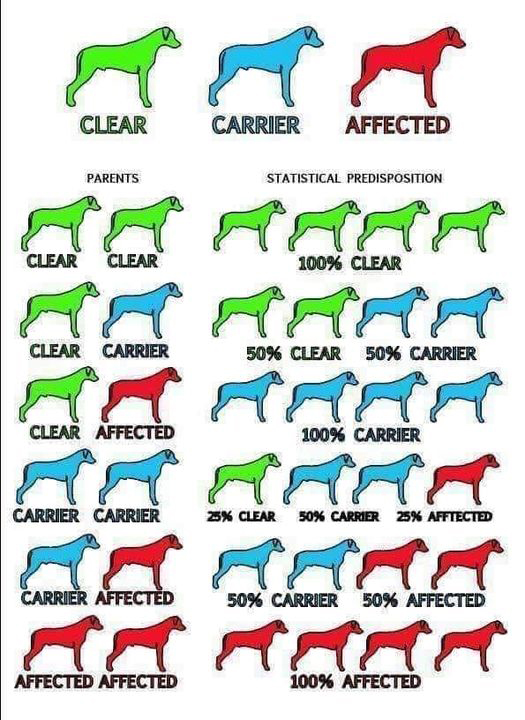
The following outcomes apply only to a simple autosomal recessive condition when the DNA test accurately identifies the relevant variant:
| Mating | Clear puppies | Carrier puppies | Affected puppies |
|---|---|---|---|
| Clear × Clear | 100% | 0% | 0% |
| Clear × Carrier | 50% | 50% | 0% |
| Carrier × Carrier | 25% | 50% | 25% |
| Clear × Affected | 0% | 100% | 0% |
| Carrier × Affected | 0% | 50% | 50% |
| Affected × Affected | 0% | 0% | 100% |
Using carriers responsibly
A carrier of a simple autosomal recessive condition is not affected by that condition. If the dog is otherwise healthy and of value to the breed, it may be used responsibly with a tested clear mate. This mating will not produce genetically affected puppies for that particular recessive variant, although some puppies may be carriers.
Automatically removing every carrier from breeding can rapidly shrink the available gene pool. A more balanced approach is to use suitable carriers carefully, test their potential breeding offspring and gradually reduce the frequency of the variant over several generations.
Using an affected dog
For some simple recessive conditions, an affected dog mated to a tested clear dog is expected to produce carrier puppies rather than genetically affected puppies. However, this does not automatically mean that such a mating is appropriate.
The welfare and health of the affected dog must come first. The severity and age of onset of the condition, veterinary advice, breed-club guidance and the overall value and diversity of the proposed mating must all be considered.
If carrier offspring may later be bred from, they must be clearly identified and their future matings carefully planned. Relevant test certificates and written breeding information should always be supplied to the new owner.
Not every condition follows the same rules
The inheritance table above applies only to simple autosomal recessive conditions. Not all inherited disorders follow this pattern.
Other conditions may be dominant, incompletely dominant, co-dominant, sex-linked, mitochondrial or polygenic. Some DNA variants indicate an increased risk rather than confirming that a dog will develop the disease.
Test results must therefore be interpreted according to the specific condition and the guidance supplied by the laboratory. Professional genetic or veterinary advice may be needed for more complex results.
Choosing appropriate tests
DNA testing allows breeders to use an increasing amount of scientific knowledge when planning matings. However, the availability of a test does not necessarily mean that it is relevant to every breed or every breeding programme.
Priority should be given to validated tests for conditions known to occur in the breed, particularly those affecting health, welfare, function or lifespan.