
There is a saying that “A Breeding Kennel is only as Good at its Bitches.”
Prologue
There are many books on the breed, but they tend to concentrate on the males, leaving the females on the side lines. Of course, a popular stud dog is going to have a bigger impact on the breed than any bitch because of the greater number of puppies he can be the sire of. But, during my research I have found at least thirty bitches who have direct lines of at least eleven generations in front of them. This is far more than most of the stud dogs in the breed. Making me believe that the bitches are rather more important than the dogs in the long run.
Before I get into the facts for the bitch lines, I think that it is a good time to sort out the origin of the Rough Collie. From my research the breed appears to be a combination of dogs from England, Scotland, Wales and Ireland, This combination came together as a breed in about 1874 to form the modern Rough Collie. Before that time they were known as Sheep Dogs.
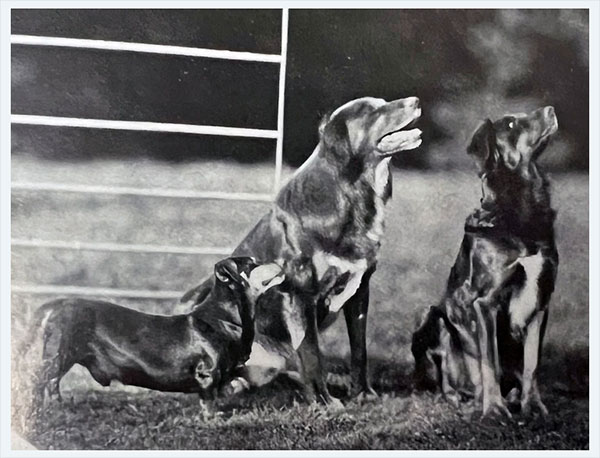
These are some of Queen Victoria’s Collies photographed in 1860. This rather demonstrates the difference from the Collies of today. I have to assume that these were Working Collies. They are very much smooth coated and could well be behind today’s Smooth Collie as well as the Rough Collie.
The English Working Collie was mainly black in colour and taller than those from the other countries. This English dog was probably used more for herding cattle due to the size of the breed and also sheep were not as common as cattle in England.
The Working dogs from the other countries were used almost exclusively for herding sheep. The start of dog shows encouraged breeders to invent a breed that would be attractive in the showring to please the judges.
Breeders in the Birmingham area were the keenest to breed a type that would appeal to dog judges and the general public. This all started in the late 1860’s and by the middle of the 1870’s huge strides had been made in establishing what was to become the Rough Collie. This work on the breed had lead to the fact that by the middle of the 1880’s we had a breed that contained exhibits good enough to win at the shows today.
To get to this position breeders used a dog called Old Cockie that was brown and white in colour and was born in England. But could have had Welsh Collie ancestors. They used a black and white Collie from Ireland called Trefoil and they used a couple of blue merle Collie bitches and two or three tricolour dogs from Scotland that were called Border Collies.
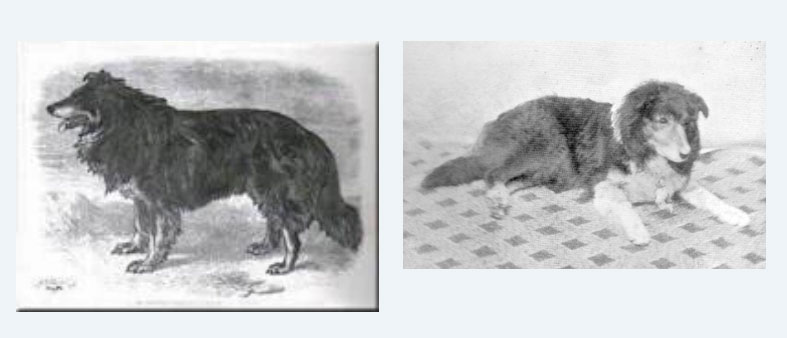
These two dogs were not Rough Collies as we know the breed today, but they were very good specimens of what we might call working Collies. And they were shown at some of the dogs shows at that time. In fact Old Cockie (he started out as Cockie but due to his show success the prefix Old was added to his name) was considered to be the best sheepdog of his time. He won at shows all over the country. Surprisingly he was not used at stud until he was eight years old. But when he was used he changed the breed because he was brown in colour and he was dominant for that colour. And it was that colour, which was to change to Sable and White that got the general public really interested in the breed so that by the end of the eighteen hundreds the breed became the most popular in the World.
A lot of inbreeding and close line breeding was practiced by these very keen breeders. We have to thank them for their expertise and dedication that resulted in probably the most beautiful breed of all.
These are some of those very keen breeders breeders from mainly the Birmingham area. Mr J Bissell, Mr M C Ashwin, Messrs. J & W Charles, Mr J D Tomlinson, Mr W A Walker and Mr J Sivitor. They evidently clubbed together to try and improve the breed. They were extremely successful.
Amazingly we actually know the birth date of Trefoil. There was much close mating here as he was mated to his daughter Elcho. From this list we know that at least five dam lines started in the 1870’s.
It has always been said that the Rough Collie is Scottish Breed. Having done a considerable amount of research I have to disagree with this. The main reason that it is a supposed Scottish breed is that Queen Victoria had them at Balmoral from 1860 onwards. From my research she liked her Collies at Balmoral, but they were Working Collies. She did not have any Rough Collies until the Rev Hans Hamilton gave her one or two in the 1880’s including a dog by the name of Darnley 11. Darnley was born on the 8th January 1888 and lived at her English country Sandringham estate. His half brother Ch Christopher was born a year later on the 14 June 1889, and he went on to win the Best of Breed award at the first all breeds Crufts show in 1891. Darnley was entered at this show but did not get a high award.
Obviously Scottish dogs were used on English Collies, but from the names of them I have to assume that they were Working Collies. I have seen a head photograph of Marcus a dog that came from Scotland and was used on English bitches with some success. From his head photo he was a Border Collie. Another that came down was Perthshire Bob and with a name like that he must have been a Working Collie. A blue merle bitch called Lassie came down south, was mated to an English dog. She was evidently a very good worker as indeed all of the dogs and bitches that were bred from in those days would have to be excellent workers otherwise, they would not be kept.
The Collies of that time were not kept as pets but were frequently sold to other breeders. The Rev Hans Hamilton came into the game during this time. He was a dominant member of The Kennel Club and was on the Crufts Dog Show Committee. He was also the president of The Collie Club for many years. He gave Queen Victoria at least one of his dogs and he is much remembered in the breed as the breeder of Ruby111, one of the great early bitches in the breed.
The most important Collie in those early days was Old Cockie. He was born on a farm at Bleasby near Nottingham which makes him an English Collie although his colouring probably means that he is from Welsh farmstock. This colour was unknown in the Border Collie and the English Collie at that time. All of his puppies were born with this colour which was later changed to Sable and White. This colour is the most popular colour for the breed, so we have to thank Old Cockie for introducing this most colourful point in the breed. Unfortunately we do not know his breeding. He was bred and owned by a Mr A White who lived in Nottingham. This dog had a spectacular show career and was acknowledged as the best of his generation. But he was not used at stud until he was eight years of age. Maybe his colour put off those who were more used to black and white Collies. But this soon changed when the general public realised how beautiful the breed was in the sable and white colour.
When he was eight years of age, he had been bought at a stock auction in Birmingham by a Mr G Tomlinson who retired him from the show ring. But he was soon bought again, this time by Mr Bissell, who used him on his own bitches with outstanding success because he bred Maude and her daughters that were to have such an enormous influence on the breed as the breeders were beginning to stamp a type for the breed.
The improvement of the Rough Collie was rapid and from the photos of some of the early dogs they would not be disgraced in the showring today.
I have found some bitch lines that have carried on for 150 years which is quite remarkable. What is also remarkable is that some Collies appear in far distant pedigrees thousands of times. My program will do a thirty five generation pedigree and this will contain many millions of Collies. A popular dog in those early days will appear quite frequently.
What other crossing was going on at this time? What other breeds were used? We do not know for certain but Borzois where suspected and indeed Queen Alexandra had them with her Rough Collies at Sandringham. Was it a Borzoi that was the dam of Sowerby Model the dog that had such a long head when long heads were in such demand in the showring? According to his pedigree his sire was a well known Rough Collie but his dam was of unknown parentage.
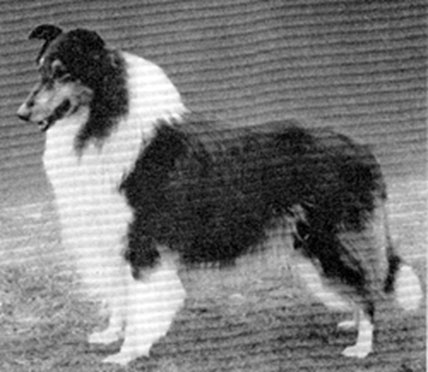 |
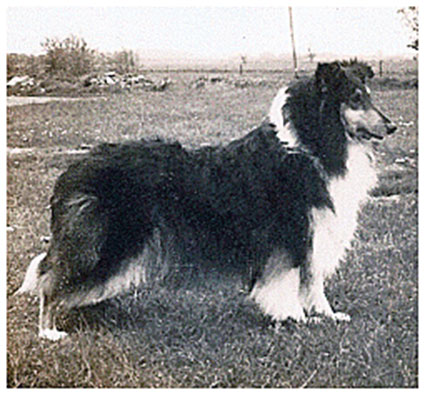 |
Ch Witchcraft Of Rokeby |
Ch Corydon Qui vive |
Champion Corydon Qui Vive is one of the most influential bitches that I have found in my extensive research for this book. She is the only bitch that I can find that has both male and female lines up to the present day with her Champion son being sired by a dog that was different to the dog that sired her Champion daughter. Champion Witchcraft of Rokeby is also there as her litter mates son and daughter lines are still going strong. Rather strange that both these bitches should be tricolours.
I have worked out a 4-generation reverse pedigree of Ch Witchcraft of Rokeby. I am amazed that in these 4 generations there are at least 65 UK Champions. She has to be the most influential Collie bitch of all time in the breed. But there is only one bitch line coming down from her and that is the Corydon line. All the other lines stopped after a maximum of four generations. Why? I have to say that I find it incredible that no other kennel based their female stock on this outstanding bitch. No other kennel used her in their breeding plans.
In this book I have headed the chapters by using the name of the bitch that started the line. I have also put in dam’s lines. That is the name of the most recent bitch at the top followed downward with the name of her dam then granddam, great grand dam until the end of the line or in other words the first bitch I can find in the line. I also use a term called reverse pedigree. This is where I name a bitch and then her offspring. A female reverse pedigree names the bitches coming after her. I.E her daughters, granddaughters, great granddaughters. A normal reverse pedigree would include her sons, grandsons etc.
Looking at the Kennel Clubs Breed Record Supplement for Autumn 2023 of the 25 litters registered in that period just three were sired by a Champion dog. Little wonder that the breed has deteriorated so that many of today’s winners would not get placed at the shows held just a few years ago.
When I started, I was told by the real experts that the best dog to use was only the cost of a stud fee. In those days it was, for the best dogs, the price of one puppy. Seeing the cost of puppies today I suspect that a stud fee for the same would not be popular with present breeders. I think that they would throw up their arms in horror if I quoted a fee of £2,000 for the services of one of my dogs. Yet why not? Further research though tends to show that the breeds gene pool is not nearly as low as we have been led to believe. I have put in an example of this by the input of the pedigree of Ch Metchley Wonder. He was the most used sire of his time and probably of all time in the breed.
Mr Wheeler wrote that he thought he was the biggest earning dog ever in the breed. His four generation pedigree shows that there are three dogs and five bitches that are entirely unrelated to each other. The dogs are Twig, Old Cockie and Marcus. The bitches are Bess, Meg, Nellie, Jessie and Lassie(Hunt’s)
One bitch that I have studied was called Nell an unregistered bitch born about 1900. She did not produce any bitches, but her reverse pedigree goes on for ever as she was the dam of two or three very popular dogs. Although she did not have a female line she was without doubt a very important bitch in her time. Her main son was Ch Balgreggie Hope that started the Old Hall kennel.
These early Collies were probably all farm dogs and presumably all were good workers because the farmers would not have kept them if they were not. They could not afford to keep dogs that were poor in this respect and would certainly not breed from them. I would imagine that not all were working Collies, but all would have been herding dogs.
Blue Merles were not uncommon but for some reason were not popular. For instance, CH Metchley Wonders granddam Catrine was the sole survivor in her litter as she was the only puppy born that was not a blue merle. Yet we have bitches that started long female lines that were blue merles.
I am finding it very difficult to get an accurate picture because so many of the early bitches were not registered at The Kennel Club. I have some old Collie Folio’s that include the names of registered Rough Collies. From this it would appear that only one or sometimes two would be registered from a litter. It is no wonder that so many bitches that had litters at the start of the bitch lines were unregistered with the unfortunate probability that the parentage of the unregistered bitch is impossible to find. Another problem is that so many had a change of name. Also, The Kennel Club allowed names to be used again and again. At one time it got to the state where the same name was being registered very frequently. This was very evident when Carol Smedley sent me a list of EDEN Collies. The total number of names that she sent was about 270 and of these 61 were repeat names. One name Eden Exclusive was repeated two times.
When I first started in the breed Margaret Osborne had been given the task by the Kennel Club to go and examine a dog to see if it was a true Rough Collie. If the animal was deemed to be a member of the breed, then it was registered at the kennel club. The problem with this is that we do not know the parents of the dog or bitch involved.
I assume that the kennel club used this system because there was no registration of dogs by the kennel club during the second world war. Of course, breeding was carried out as it is quite difficult to keep a randy dog away from an in season bitch. However, some breeders such as Mrs George of Beulah fame did manage to do some breeding, and it is thanks to them that we are able to confirm the pedigrees of many of the dogs born during that period.
My next question is why it is called a sheepdog? I worked on farms for a number of years and on one farm I managed a herd of 500 cattle and a flock of 1500 sheep. I used my Rough Collies to help me, and I noticed that they were much happier with the cattle than the sheep. In fact, my bitches did not really want to work with the sheep at all.
This breed could quite likely have been bred for looking after cattle as there are and indeed were a lot of cattle in England. The Rough Collie is actually rather too big to herd sheep. They are also more aggressive than the Border Collie which works silently. The Rough Collie when it is working tends to bark and will nip the hind legs of any animal that is lagging behind. A working Border Collie would never do that.
The English Working Collie was quite a bit taller than the Scottish Border Collie. They were mainly black in colour with just the odd white on the end of the tail and sometimes white collars. They were like todays Rough Collies in that their feet were small and they were loose limbed.
Having gone into this in some detail I suspect that a lot of crossing was going on. Certainly, Marcus one of the early sires did look more like a Border Collie than the Rough Collie he was alleged to be. There have been talks about Borzois and Deerhounds coming into the equation, but I think that these were probably wrong, or if they did occur then they did not carry on into future bloodlines.
It is very strange that the family that was most common when Miss Osborne published these lines and was so for some twenty years is now almost extinct. She gave each female line a number therefore this one was Family 1. Why have so many of the winners in that period not in any of the family lines today?
This is not unusual either because the big winning producing bitches in the late 1800’s have also become unknown today. I know that we seem to be heading in that direction as well as far too many of our bitches are producing male puppies that are of better quality, show wise than their litter sisters. I can easily see how these bitch lines just fade away.
Then the new bitch lines cannot be traced back because the bitch at the start of the line was either not shown or her dam was not. Nearly all of our bitches were or are in Margaret Osborne’s Family 2 and we now know that this family goes back to the 1870’s and is one of the few lines that we can trace back to those times. Fortunately, there are very many bitches from other leading kennels who are in this family.
Another unfortunate fact is that there are so few photos or illustrations of the early bitches. This is very sad as I would love to have seen what they looked like. I have unearthed a few photographs of the early bitches but all too often they do not appear in these bitch lines.
I suspect that like a lot of very good bitches from the show points were not too good at reproducing themselves. Plenty of early dog pictures but the only really early photo of a bitch is one taken of Ch Madge and she is posed sitting down. We have an illustration of Champion Peggie 11 who was the dam of one of the all time greats Ch Christopher the first Best of Breed winner at Crufts Dog Show.
From my research so far, it has become very apparent that very few Champion bitches actually produced Champions themselves. I remember speaking to a Capt. De Quincy who was a very famous and extremely successful Hereford Cattle breeder and exhibitor. He rather dominated the cattle show scene during the 1950’s. He told me that he had two herds with one for showing and the other for breeding. He did not breed from the show animals because he said they were too pretty to make good breeders. His best show stock came from the unshown cows in his breeding herd.
I have to say that his comments are very practical as the Champion bitches we have had in this kennel only three were successful as breeders and of these only Ch Corydon Hippolyta was what I would call a pretty bitch. She produced two UK Champions for us, while Ch Corydon Qui Vive and Ch Corydon La Stupenda were much more matronly in appearance. While others like Ch Corydon Kittycat did not produce any puppies at all. She was a very pretty bitch but was hopeless when it came to breeding from her. In fact, several of our top winning bitches never produced puppies. These included Ch Corydon Madchen and Ch Corydon Polly Hera.
On this theme I remember when I was a farm manager my employer, the owner of the farm, wanted to increase the number of cows in his milking herd. We visited several farms that were dispersing their herds. On one we visited the cows were producing enormous amounts of milk, but they were in a cowshed while I milked in the first milking parlour built in this country. They were of no use to us as their udders were nearly on the ground therefor totally unsuitable for my job.
One farm we did purchase from was a large herd with some really nice young heifers and cows. My employer was very taken with a very pretty cow that had become a Champion at several agricultural shows. I felt she was far too pretty to be a good milker and I rather preferred anther young cow who I thought would make a very good milker. My Boss bought them both but the pretty one soon went away as her milk production was very poor. The cow I liked, which was, for me, very good looking and became my top milker in the herd.
What I have learnt from this is that it is not always the best-looking animal from the show point of view but the more honest and substantial animal that will produce the best stock.
I do have a problem tracing early Collies as so often they were sold, and the new owner changed the name. In one case a bitch called Katrine had her name changed to Lassie by her new owner. Fortunately, Katrine won her way into the Kennel club Stud book. It all came to light when Lassie had a litter that was registered at the Kennel Club, and she had the same stud book number as that won by Katrine therefor, we now know that Lassie started life as Katrine.
Dareen Bridge in her book had a bitch line coming from litter sisters called Scott and Clyde. But further research rather proves that Scott and Clyde were not litter sisters as I can find no bitches called Scott, but plenty of dogs were called that name and the same goes for Clyde. But in this particular case she was a bitch. Therefore I have decided that these are two different families.
This problem of lines dying out is not just confined to the bitch lines either. It does seem very strange that no Rough Collies today go back tail male to the two top Champion producing sires in the breed. Ch Lochinvar of Ladypark was the sire of 13 Champions, and Ch Arranbrook Mr Chips of Aberhill was also the sire of 13 Champions.
Ch Eden Emerald success as a sire in America was assumed to be because he was by Ch Poplar Perfection who was by Ch Magnet. But I have been reading a new American book on the breed where it has a quote from Dr Bennett one of the greats in that country where he is quoted as saying that Emerald’s dam Ch Eden Elenora was in his opinion the most beautiful bitch he had ever seen. So why is she never mentioned when the success of Emerald is discussed. She was the dam of five UK Champions as well as being beautiful. One of the main reasons I am writing this book is that all too often the dam of a Champion is ignored if that Champion is by a well known sire.
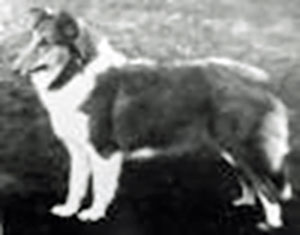 |
Ch Eden Elenora |
One of the most interesting facts to come from my research is that some bitches were for some reason wonderful producers. For instance a bitch born in about 1885 called Sweet Lassie was one of these. She produced at least three bitches that were at the start of their own line. She also produced dogs that were to have a big impact for breeders. I did an eight generation reverse pedigree of her that covered about ten pages. She was without doubt one of the most prolific dams in my database. Why she should do this is beyond my comprehension. The bitches before her did not produce anything apart from the bitch that followed them. Her sire was a well known dog called Young Cockie that was not a son of the very famous Old Cockie but a great Grandson. I have to assume that all Collies born today will have her in their pedigree several times and in fact could be hundreds of times.
Another bitch that comes into this category was Leecroft Black Magic that was born in 1954. Her offspring numbers are legion yet those before her were not prolific producers, and her pedigree was not brilliant. I have to wonder why she was called Black Magic because she was magical as a producer. Below is her four generation pedigree There are only three Champions in this pedigree. A rare example of an outcross mating being successful. I cannot find a photograph of this wonderful bitch.
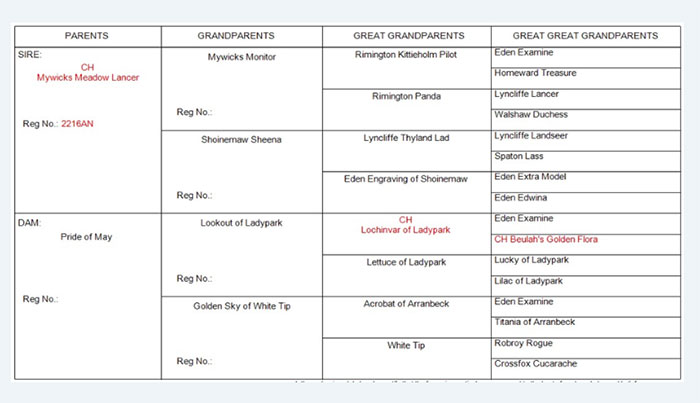
What surprises me is how healthy the breed is even with this very low gene pool. Apart from some eye problems the breed is much healthier than most other breeds. Hip problems really do not exist, at least not to the same extent as this problem is in Border Collies or German Shepherd Dogs that do a similar job on the farm.
While I am on this subject, I have to write that the Smooth Collie is a very different breed to the Rough Collie. I know that in many countries they are crossing the two breeds. But they do a completely different job on the farm.
The Rough Collie is the herding dog while the Smooth Collie is the driving dog. In other words, the Rough Collie looks after and rounds up the herd while the Smooth drives the herd to market. They do a completely different job, and they are structurally very different.
The Rough is very loose limbed as he is always lying down and getting up as he controls the herd or flock while the Smooth is much tighter limbed as he is always on his feet when doing his job. To show this in practice, just put your hand on the back of a Rough Collie and you will find it dropping down and is easily moved on the back. Do the same action to a Smooth and you will find that it does not move when you put your hand on its back. It feels much more solid under your touch.
This is probably one of the few times that I agree with any of the Kennel Club’s rules, as they will not allow the registration of puppies born from a cross between the two breeds.
Being loose limbed the Rough Collie is unique as it is one of the only breed that are constructed like that. This is probably the main reason why it is so unpopular with the All-rounder judges. They obviously think that this is a sign of unsoundness. They cannot get their minds to accept the fact of this loose limb in the breed.
Now for the bitch lines. So far, I have found at least 26 bitches who are at the head of 11 or more generations of bitches in direct line.
There are bitches that have no bitch lines but were the dams of famous dogs. One that comes to mind is a bitch called Pickwick Peeper whose main claim to fame is that she was the dam of the great Ch Poplar Perfection. All Rough Collies go back to him in direct male line.
What other crosses were made in that period, and I am talking about the years from 1870 to 1890? I have to wonder as some extremes in type appeared. Extra long heads became the rule for a time. Extreme height was also common.
This is probably the reason why the American Breed Standard for the Rough Collie has the height two inches taller than the English Breed Standard. However the breed seems to have been fairly pure since about 1900.
From pictures of the breed during that period I have to say that the main winners and ancestors of the breed from that time were good enough to win at shows today. Certainly from their photographs Ch Metchley Wonder and his son Ch Christopher would not look out of place in the showring today.
TO BE CONTINUED.........The original article with any subsequent updates after publication on Collielife can be found HERE
