
The Raw Versus Kibble Debate
What does the available evidence tell us?
Few subjects in canine nutrition create as much disagreement as raw feeding and dry kibble. Owners may be told that raw food is the only natural choice, or that it is inherently dangerous. Neither position reflects the full picture.
Dogs can be maintained successfully on several types of food, including raw, fresh cooked, wet and dry diets. The essential requirement is that the diet provides the right balance of energy, protein, fats, vitamins and minerals for the individual dog’s age, health and lifestyle.
Can a Raw Diet Be Complete?
Yes. A properly formulated raw diet can meet a dog’s nutritional needs. Commercial raw foods described as complete should be formulated to provide all the nutrients required when fed according to the manufacturer’s directions.
A food labelled complementary is not intended to provide every required nutrient by itself. This includes many 80:10:10 products, minced meat mixes, bones and treats.
A homemade raw diet can also be balanced, but meat, offal and bone in a fixed ratio do not automatically supply every nutrient in the right quantity. Iodine, vitamin D, vitamin E, essential fatty acids and several trace minerals can be low or excessive depending on the ingredients used.
What Does the Research Show?
Research into raw feeding has increased. Studies have shown that some raw or fresh meat diets can be highly digestible and can produce smaller stools. Different diets also alter the collection of organisms and metabolites in the dog’s digestive system.
Owner surveys and observational studies have reported associations between feeding practices and conditions such as allergies, digestive health and orthopaedic disease. These findings are useful for directing further research, but an association does not prove that the diet caused or prevented the condition.
Small feeding trials can show that a particular recipe maintained the dogs during the study period. They cannot establish that all raw diets are complete or that raw feeding prevents disease throughout a dog’s lifetime.
Kibble Is Processed Food
Kibble is manufactured by combining ingredients and usually cooking them under heat and pressure before drying and coating the finished pieces. This makes it convenient, shelf-stable and economical, but it is unquestionably a processed food.
Processing can change the structure and availability of some nutrients. Manufacturers may add vitamins, minerals and other nutrients to ensure that the finished product meets its formulation rather than relying solely upon the naturally occurring nutrients in the original ingredients.
This does not mean that every kibble is harmful or nutritionally poor. Products vary considerably in their formulation, ingredients, digestibility, quality control and suitability for an individual dog. The same variation exists between different raw foods.
No Pet Food Is Guaranteed Sterile
Kibble has undergone a cooking stage intended to reduce microorganisms, but that does not guarantee that the finished food can never become contaminated. Dry, wet and raw pet foods have all been subject to recalls involving bacteria, mould toxins, nutrient errors or foreign material.
Raw food has not undergone an equivalent cooking stage, so careful sourcing, storage and preparation are especially important. That does not mean that an owner cannot handle it responsibly.
Food Hygiene and Bacteria
Raw meat used for dogs should be handled with the same care as raw meat intended for the family. Use separate chopping boards and utensils where possible, wash hands thoroughly, clean bowls after every meal and disinfect surfaces that have come into contact with the food.
Frozen food should be defrosted in the refrigerator rather than left at room temperature. Store it in a sealed container, follow the manufacturer’s instructions and discard food that has been left uneaten for too long.
Dogs often tolerate exposure to organisms without showing obvious illness, but this does not mean that every dog is protected. Puppies, elderly dogs and dogs with an illness or weakened immune system may be more vulnerable. Apparently healthy dogs can also carry and shed bacteria in their saliva or faeces.
Extra caution is sensible in households containing babies, young children, pregnant women, older people or anyone with a weakened immune system. This is a matter of sensible hygiene and individual risk assessment rather than a reason to condemn every owner who feeds raw.
Raw and Kibble Compared
| Consideration | Raw food | Dry kibble |
|---|---|---|
| Processing | Usually minced or portioned and then chilled or frozen without a cooking stage. | Ingredients are usually mixed, cooked or extruded, dried and sometimes coated after cooling. |
| Moisture | Contains a high proportion of moisture, so raw-fed dogs may drink less from their water bowl. | Contains little moisture. Fresh drinking water must always be available, and water can be added to the meal if preferred. |
| Nutrition | Can provide complete nutrition if correctly formulated. Some raw products are only complementary. | Can provide complete nutrition if correctly formulated. Quality and ingredients vary between products. |
| Hygiene | Requires disciplined raw-meat handling because there is no cooking stage intended to destroy pathogens. | Cooking reduces microbiological risk, but contamination and recalls can still occur after processing or during storage. |
| Storage | Requires adequate refrigerator or freezer space and careful defrosting. | Convenient to store, carry, measure and feed. It must be kept cool and dry after opening. |
| Cost | The cost varies greatly between homemade, subscription and complete commercial products. | Available across a wide range of prices, from economy to specialist formulations. |
| Suitability | May suit many dogs, but the fat, bone or fibre content of a particular product may not suit every dog. | May suit many dogs, but ingredients, calorie density and processing differ greatly between brands. |
Carbohydrates
Dogs do not have a separately defined dietary requirement for carbohydrate in the same way that they require certain amino acids and fatty acids. They can, however, digest appropriately cooked starch and use it as a source of energy.
The fact that a nutrient is not classed as essential does not automatically make it harmful. Fibre and suitable carbohydrate ingredients can contribute energy, stool quality, digestive function and the texture required to manufacture some foods.
Equally, a dry food containing a large proportion of inexpensive starch should not automatically be regarded as an ideal diet. Owners may reasonably prefer a food containing more clearly identified animal ingredients and less starch.
Claims that carbohydrate by itself causes cancer, pancreatitis, bloat or allergies are not established. These are complex conditions with several possible genetic, dietary, environmental and medical influences.
Protein, Fat and Digestibility
Many raw diets are comparatively high in animal protein and fat and low in carbohydrate. They can be highly palatable and digestible, and some owners report improvements in coat, stool quality and appetite.
These changes may be genuine without proving that raw food itself is a cure. An improvement could result from changing the protein source, removing an ingredient that did not suit the dog, altering the fat or fibre content, or simply feeding a more digestible diet.
A high-fat raw food will not suit every dog. Dogs with pancreatitis, certain digestive disorders or medical conditions may require a carefully controlled diet prescribed with veterinary guidance.
Raw Bones
Some raw feeders use edible raw bone as a source of calcium and phosphorus. The quantity must be appropriate because excessive bone can cause hard, chalky stools or constipation and may make the mineral balance unsuitable, particularly for a growing puppy.
Bones can also break teeth, become lodged in the mouth or throat, or cause an intestinal blockage or injury. Cooking makes bones more likely to splinter, but raw bones are not completely free from risk.
Dogs should be supervised and given a bone appropriate to their size and chewing style. Weight-bearing bones from large animals can be extremely hard and may fracture teeth.
Is 80:10:10 Complete?
The commonly used 80:10:10 ratio generally means:
- 80% muscle meat, which may include heart and other muscular tissue.
- 10% edible bone.
- 10% offal, often divided between liver and another secreting organ.
This can provide variety and many useful nutrients, but the ratio is a feeding model rather than a complete nutritional analysis. Its adequacy depends upon the animals, cuts, organs and bone used.
Some mixtures may be low in iodine, vitamin D, vitamin E, manganese, zinc, copper or essential fatty acids. Others may contain excessive calcium, liver, fat or particular minerals.
Commercial 80:10:10 products are therefore commonly labelled complementary unless additional ingredients have been included to make them complete.
Feeding Puppies
Puppies require sufficient energy and a particularly careful balance of calcium, phosphorus and other nutrients. Large-breed puppies are especially vulnerable to skeletal problems caused by excessive or deficient mineral intake.
A puppy can be raised on raw food, but the diet should be expressly formulated as complete for growth and suitable for the puppy’s expected adult size. Simply feeding more of an adult recipe does not necessarily meet a puppy’s needs.
Percentage-of-body-weight feeding charts can provide a starting point, but young puppies grow rapidly and individual requirements vary considerably. Monitor weight and body condition frequently and adjust the amount rather than following a fixed percentage regardless of the puppy’s development.
Pregnant and Nursing Bitches
Pregnancy and lactation place substantial demands on a bitch. A suitable diet must provide enough energy, protein, calcium and other nutrients without creating dangerous imbalances.
A complete food formulated for reproduction or growth is generally the simplest option. Avoid making large changes to bone, calcium or supplements according to an unverified weekly formula. The bitch’s condition, litter size and food intake should be monitored, with veterinary advice where necessary.
How Much Raw Food Should an Adult Dog Eat?
A commonly quoted starting point is approximately 2–3% of the dog’s body weight each day. This is only a guide, not a nutritional rule.
A small active dog may need a higher percentage, while a large, elderly, neutered or less active dog may require considerably less. Foods also differ in calories, particularly according to their fat content.
Assess the dog’s weight, waist, ribs, muscle condition, stools, activity and overall health. Increase or reduce the portion accordingly. The feeding guide provided with a complete commercial product should also be considered.
Changing Diet
Some dogs can change foods quickly without difficulty, while others develop vomiting, diarrhoea or constipation if the transition is too sudden. A gradual change over several days is usually the more cautious approach.
Begin with a small amount of the new food and increase it while reducing the old food. Dogs with chronic digestive disease, pancreatitis or another medical condition should have an individual transition plan agreed with their veterinary surgeon.
There is no general requirement to starve a healthy dog or deliberately skip meals before changing from kibble to raw food.
Allergies, Skin Problems and Digestive Conditions
Some owners report that itching, recurring ear problems or digestive symptoms improve after changing to a raw diet. These experiences should not be dismissed, particularly when an individual dog’s improvement is clear.
However, the improvement may result from changing the ingredients rather than from the food being raw. A dog with an adverse reaction to a particular protein or ingredient may improve when that ingredient is removed, whether the replacement diet is raw, cooked, wet or dry.
A properly conducted elimination diet usually requires a carefully selected novel or hydrolysed protein and strict feeding for a defined period. Randomly changing between several meats may make it more difficult to identify the cause.
Steroids and other veterinary medicines should not be stopped suddenly without veterinary advice. An improvement following a dietary change can be discussed with the vet so that any medicine is reduced safely where appropriate.
Can Raw Feeding Prevent Disease?
Diet is an important part of health, but strong claims that one type of food prevents cancer, hip dysplasia, bloat, pancreatitis or every chronic illness go beyond the available evidence.
Genetics, body weight, exercise, age, infection, environment and chance may all contribute to disease. Nutrition can influence risk and may support the management of some conditions, but it should not be presented as the sole cause or cure without reliable evidence.
Research into early diet and later disease is interesting, including studies from the University of Helsinki. Much of this work is observational and relies on information reported by owners. It can identify associations and generate valuable questions, but it cannot prove cause and effect on its own.
What About the Gut Microbiome?
Studies show that raw, cooked and dry diets can produce different intestinal bacteria and different fermentation products. Raw and fresh meat diets have sometimes been associated with higher protein and fat digestibility and smaller faecal volume.
A difference in the microbiome is not automatically an improvement or a harm. Research has not yet established one ideal microbiome that applies to every healthy dog.
Claims that a specific microbiome change will calm a dog, prevent depression or cure disease require more evidence. Behaviour is affected by genetics, learning, environment, pain, health and many other factors.
Complete Food and Supplements
The word complete means that a food is intended to provide all the nutrients required in the daily ration for the stated species and life stage. It does not mean that every complete food is identical or equally suitable for every dog.
Adding blueberries, vegetables, fish oil or another ingredient to a complete food does not prove that the original food was deficient. Some additions may provide a particular effect beyond the minimum nutritional requirement, while others simply add variety or calories.
Supplements are not automatically harmless. Fish oil, calcium, vitamins, minerals and herbal products can cause an imbalance or interact with medication when used inappropriately.
Choosing a Raw Food
When buying a commercial raw food, check:
- Whether it is labelled complete or complementary.
- The species and life stage for which it is formulated.
- Whether the manufacturer follows recognised nutritional guidelines.
- Who formulated the food and what nutritional expertise they have.
- Whether finished products are analysed and subjected to quality checks.
- How ingredients are sourced, transported and stored.
- The calorie, fat, bone and nutrient content.
- Whether the company provides batch numbers and clear recall information.
- Whether it gives proper storage, defrosting and hygiene instructions.
Owners preparing food at home should use a properly formulated recipe rather than relying entirely on ratios collected from social media. Advice from a suitably qualified veterinary nutrition professional can be especially valuable for puppies, breeding bitches and dogs with medical conditions.
Choosing a Kibble
When considering a dry food, check:
- Whether it is complete and suitable for the dog’s life stage.
- The food’s calorie density and feeding guide.
- Whether the manufacturer employs suitably qualified nutrition experts.
- What quality-control and finished-product testing are carried out.
- Whether the manufacturer can provide a typical nutrient analysis.
- How the dog’s weight, coat, stools, appetite and health respond to it.
Marketing descriptions such as “premium”, “natural” and “holistic” do not have the same meaning as a complete nutritional analysis. Price alone does not prove quality.
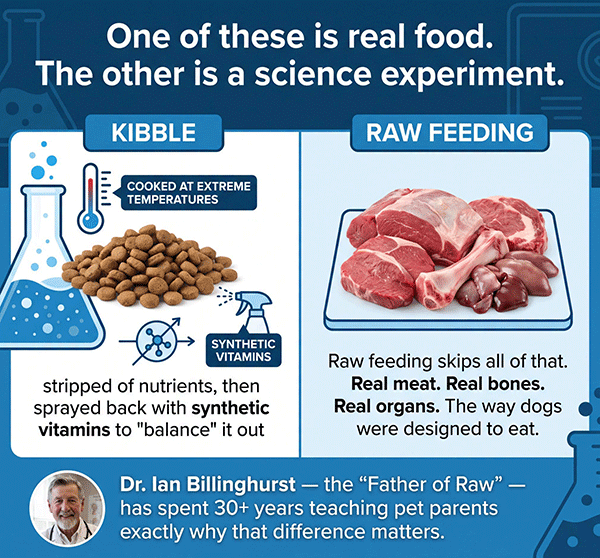
Read more about Dr Billinghurt HERE
Respecting an Owner’s Choice
Owners who feed raw should be able to discuss their dog’s diet with their veterinary practice without being dismissed or made to feel irresponsible. Likewise, owners who feed kibble should not be accused of harming their dog simply because they have chosen a processed food.
Constructive advice should concentrate on whether the particular diet is nutritionally appropriate, whether the dog is thriving, and whether any identifiable risks are being managed.
Preventive care decisions—including vaccination, titre testing, flea treatment and worm control—should be considered separately according to the dog’s individual risk, lifestyle and veterinary history. Feeding raw does not by itself remove the need for protection against parasites or infectious disease.
Dr Conor Brady and Feeding Dogs
Dr Conor Brady’s book, Feeding Dogs: The Science Behind the Dry Versus Raw Debate, presents a detailed argument in favour of raw and fresh feeding. It combines published research with his interpretation of canine nutrition and his personal experiences with dogs.
The book has encouraged many owners to examine pet-food ingredients and question long-established feeding practices. As with any book advocating a particular position, its conclusions should be considered alongside the original studies and evidence from other qualified sources.
Feeding Dogs: The Science Behind the Dry Versus Raw Debate

The book is available in paperback and Kindle format from Amazon .
In Summary
- A correctly formulated raw diet can meet a dog’s nutritional needs.
- Raw food is not automatically complete merely because it contains meat, bone and offal.
- Kibble is processed, but processing does not automatically make a food harmful.
- Processed pet food can still become contaminated and may be recalled.
- Raw meat can be handled safely using the same disciplined hygiene applied when preparing raw meat for household meals.
- Raw diets may be highly digestible and suit many dogs.
- Research into possible health benefits is growing, but many long-term claims remain unproven.
- The individual food and the individual dog matter more than labels and slogans.